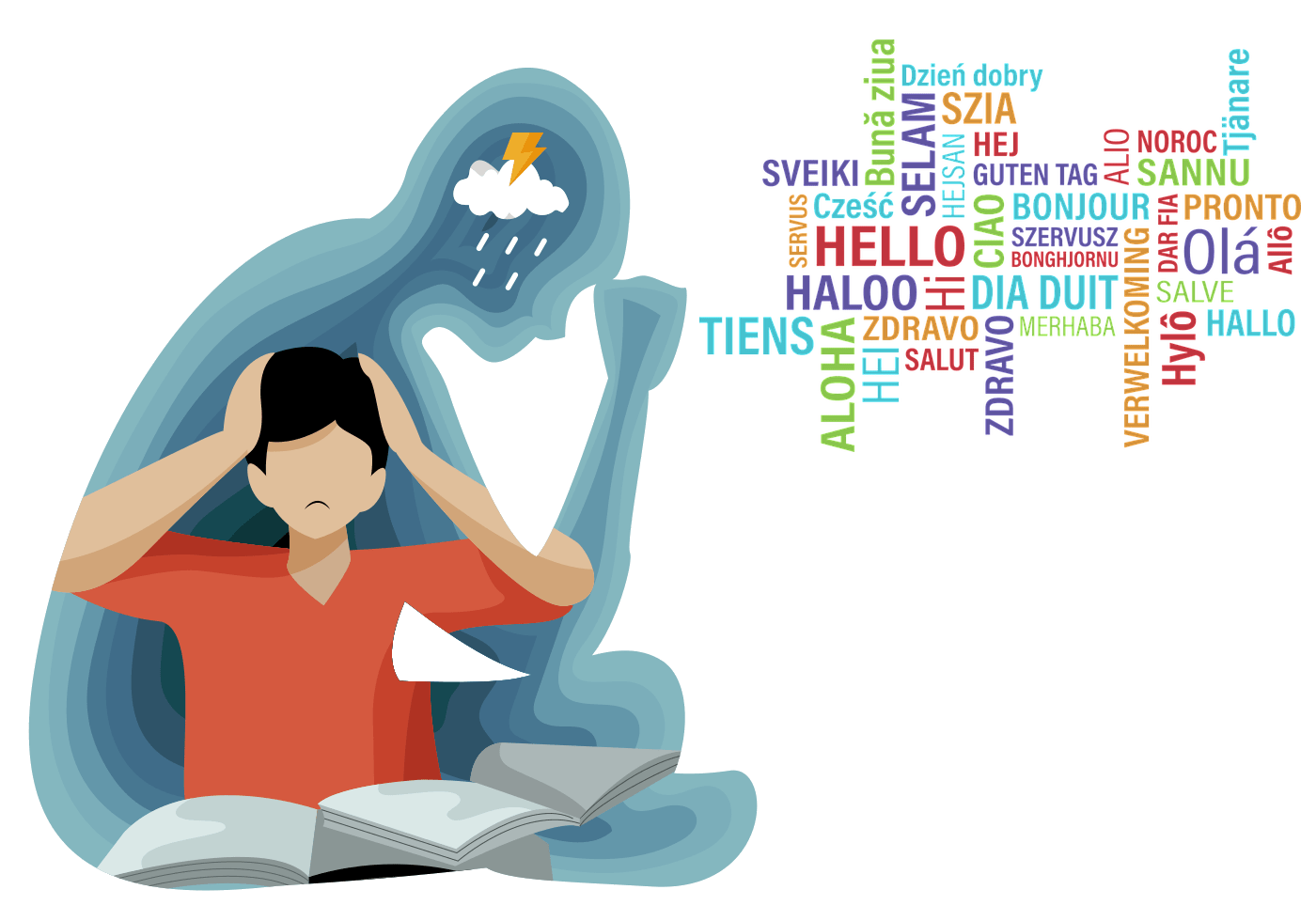
Have You Ever Forgotten Simple Words During a Conversation?
Imagine this situation:
You’ve practiced English for years. You know the grammar, you’ve memorized thousands of words, and you’ve successfully completed language exams. But the moment you’re asked a simple question during a job interview or an important presentation, your mind suddenly goes blank.
The vocabulary disappears.
Your pronunciation feels awkward.
Even constructing a simple sentence becomes difficult.
If this has happened to you, you’re not alone. Many language learners experience a dramatic decline in performance when they are under pressure. The reason isn’t that they suddenly forget the language—it is that stress changes the way the brain processes language.
The Brain’s Stress Response
Stress is a natural survival mechanism.
When the brain detects a threatening or highly demanding situation, it activates the fight-or-flight response.
Within seconds, the body releases stress hormones such as adrenaline and cortisol, preparing us to react quickly.
This response was essential for our ancestors facing physical dangers.
However, the modern brain often reacts the same way to situations such as:
- Speaking in front of an audience
- Job interviews
- Oral language exams
- Conversations with native speakers
- Public presentations
Although these situations are not physically dangerous, the brain may still interpret them as stressful.
Cortisol: Helpful in Small Amounts, Harmful in Excess
Cortisol is often called the body’s primary stress hormone.
In moderate amounts, cortisol helps us stay alert and focused.
But when cortisol levels become too high, it begins to interfere with several cognitive processes that are essential for language learning and communication.
Research suggests that elevated cortisol can impair:
- Working memory
- Attention
- Word retrieval
- Decision-making
- Cognitive flexibility
This is one reason why finding the right word becomes much harder during stressful conversations.
The Role of the Amygdala
At the center of the brain’s emotional processing system is a small almond-shaped structure called the amygdala.
The amygdala constantly evaluates potential threats.
When it detects danger—or even the possibility of social embarrassment—it sends alarm signals throughout the brain.
For language learners, the fear of making mistakes or being judged may activate the amygdala, increasing anxiety and making communication more difficult.
When the Prefrontal Cortex Loses Control
The prefrontal cortex is responsible for many higher cognitive functions, including:
- Planning
- Attention
- Problem-solving
- Language control
- Decision-making
Under high levels of stress, the influence of the prefrontal cortex decreases while emotional brain systems become more dominant.
As a result, language learners may struggle to:
- Organize their thoughts
- Build grammatical sentences
- Retrieve familiar vocabulary
- Monitor their own speech
The knowledge is still stored in the brain—it simply becomes harder to access.
Why Do Words Suddenly Disappear?
Many learners believe they have forgotten everything when they become nervous.
In reality, the words usually remain stored in long-term memory.
The problem lies in retrieval.
Stress disrupts communication between memory systems and language networks, making familiar vocabulary temporarily inaccessible.
This explains why you may remember the missing word minutes—or even seconds—after the stressful situation has ended.
The Foreign Language Anxiety Effect
Researchers use the term Foreign Language Anxiety (FLA) to describe the stress specifically associated with learning and using another language.
People experiencing high levels of FLA often report:
- Fear of making mistakes
- Worry about negative evaluation
- Avoiding speaking opportunities
- Mental blocks during conversations
- Reduced confidence
Interestingly, this anxiety can affect highly proficient speakers as well as beginners.
Can Stress Ever Improve Performance?
Surprisingly, yes.
Not all stress is harmful.
Psychologists distinguish between eustress (positive stress) and distress (negative stress).
A moderate level of stress can actually improve concentration, motivation, and alertness.
This relationship is often described by the Yerkes-Dodson Law, which suggests that performance improves with increasing arousal up to an optimal point. Beyond that point, excessive stress begins to reduce performance.
The goal is therefore not to eliminate stress completely but to manage it effectively.
How to Reduce Stress While Speaking a Second Language
Neuroscience and educational psychology offer several evidence-based strategies.
Language learners can reduce anxiety by:
- Practicing speaking regularly.
- Simulating real-life conversations.
- Accepting mistakes as part of learning.
- Using deep breathing before speaking.
- Preparing key vocabulary in advance.
- Building confidence through gradual exposure.
The more frequently the brain experiences successful communication, the less threatening future conversations become.
What Does Neuroscience Teach Us?
One of the most encouraging discoveries in neuroscience is that repeated positive experiences can reshape the brain.
Through neuroplasticity, the brain gradually learns that speaking a foreign language is not a threat.
Over time, stress responses become weaker, confidence increases, and communication becomes more automatic.
This is why experienced language learners often appear calm during conversations—they have trained both their language skills and their brains.
Conclusion
Difficulty speaking a second language under stress is not a sign of poor ability or inadequate preparation. It is a normal consequence of how the brain responds to pressure.
Stress hormones, emotional processing, and memory retrieval all interact to influence language performance. When anxiety becomes too intense, the brain prioritizes survival over communication, making it harder to access words and construct fluent speech.
The encouraging news is that the brain is highly adaptable. With repeated practice, supportive learning environments, and effective stress-management strategies, language learners can gradually reduce anxiety and communicate with greater confidence.
In the end, successful language learning is not just about mastering vocabulary and grammar—it’s also about helping the brain feel safe enough to use them.